


As a propane tank gauge supplier, I am often asked about the different types of propane tank gauges available in the market. Propane is a versatile and widely used fuel, powering everything from grills and heaters to industrial equipment. Ensuring that you have an accurate and reliable way to monitor the propane level in your tank is crucial for both safety and convenience. In this blog post, I will explore the various types of propane tank gauges, their features, and how they can benefit you.
Float Gauges
Float gauges are one of the most common types of propane tank gauges. They work on a simple principle similar to the float in a car's fuel tank. A float is placed inside the propane tank, which rises and falls with the level of the propane. This float is connected to a mechanical arm that moves a needle on a gauge outside the tank, indicating the level of propane.
One of the advantages of float gauges is their simplicity. They are relatively inexpensive to manufacture and install, making them a popular choice for residential propane tanks, such as those used for grills. However, they do have some limitations. Float gauges can be affected by the movement of the tank, which may cause the float to give an inaccurate reading. Also, they are typically only accurate when the tank is in an upright position.
Dial Gauges
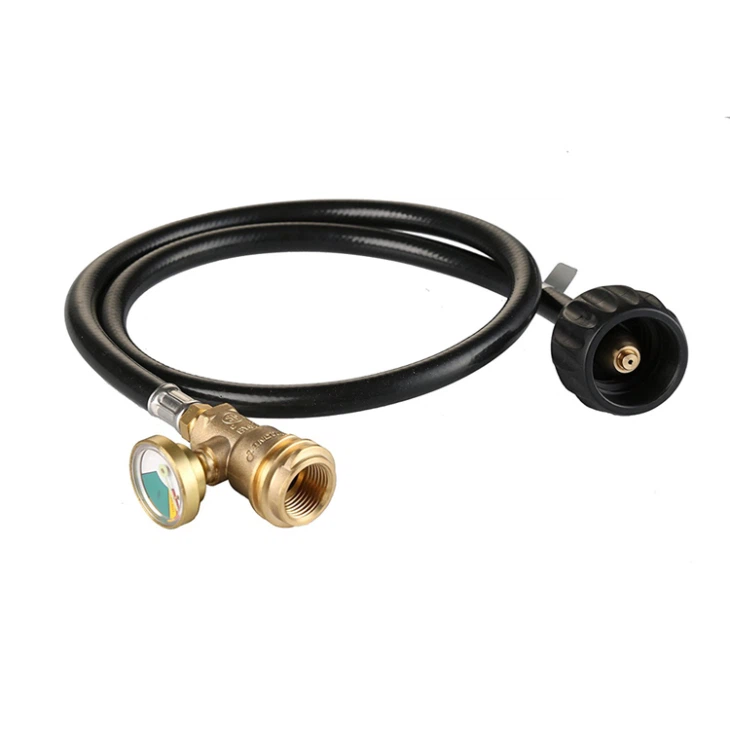
Dial gauges are another type of mechanical gauge that provides a visual indication of the propane level in the tank. These gauges are often installed directly on the valve of the propane tank. They use a pressure - based system to estimate the propane level.
The propane in the tank is in a liquid state at normal conditions, but there is also a layer of propane vapor above the liquid. The pressure of this vapor is related to the amount of liquid propane in the tank. The dial gauge measures this vapor pressure and converts it into a reading of the propane level.
Dial gauges are more accurate than float gauges in some situations, especially for larger propane tanks. They are also more stable and less affected by the movement of the tank. However, they can be influenced by temperature changes. As the temperature rises, the vapor pressure in the tank increases, which can lead to a false - high reading on the gauge.
Digital Gauges
Digital gauges are a more advanced option for monitoring propane levels. They use electronic sensors to measure the propane level and display the information on a digital screen. This provides a more precise and easy - to - read measurement compared to mechanical gauges.
One of the main advantages of digital gauges is their accuracy. They are less affected by temperature and movement, and can provide real - time updates on the propane level. Some digital gauges can also be connected to a smartphone or other device via Bluetooth or Wi - Fi, allowing you to monitor the tank level remotely.
However, digital gauges are generally more expensive than mechanical gauges. They also require a power source, which can be a drawback in some situations.

Ultrasonic Gauges
Ultrasonic gauges use ultrasonic waves to measure the level of propane in the tank. The gauge sends out ultrasonic waves that bounce off the surface of the propane and return to the sensor. By measuring the time it takes for the waves to return, the gauge can calculate the distance to the propane surface and determine the level in the tank.
Ultrasonic gauges are non - invasive, which means they do not need to be installed inside the tank. This makes them suitable for tanks where installation of other types of gauges may be difficult or impossible. They are also very accurate and can work in a wide range of temperatures.
The main disadvantage of ultrasonic gauges is their high cost. They are more expensive than most other types of gauges, which may make them less accessible for some users.
Magnetic Gauges
Magnetic gauges use magnetic fields to detect the level of propane in the tank. A magnetic float is placed inside the tank, and a sensor on the outside of the tank detects the position of the float through the tank wall. This information is then used to display the propane level on a gauge.
Magnetic gauges are relatively simple and reliable. They are not affected by temperature as much as some other types of gauges, and they can provide a clear and accurate reading. However, they require a tank with a non - magnetic wall, which may limit their use in some applications.
Quick Connectors and Tanks
In addition to gauges, we also offer a range of Propane Quick Connectors W/o Ball Valve and Propane Quick Connectors W/Ball Valve. These connectors are designed to make it easy to connect and disconnect propane tanks from appliances. Quick connectors without a ball valve are simpler and more cost - effective, while those with a ball valve provide an additional level of safety by allowing you to shut off the propane flow easily.
Choosing the Right Gauge
When choosing a propane tank gauge, there are several factors to consider. The size of the tank is an important consideration. Larger tanks may require more accurate gauges, such as digital or ultrasonic gauges. The frequency of use of the propane also matters. If you use propane regularly, a more accurate gauge will help you avoid running out of fuel unexpectedly.
The environment in which the tank is located is another factor. If the tank is exposed to extreme temperatures or rough handling, a gauge that is less affected by these conditions, such as a digital or magnetic gauge, may be a better choice.
Cost is also an important consideration. While more advanced gauges offer greater accuracy and features, they may not be necessary for all applications. For a simple residential grill tank, a float or dial gauge may be sufficient.
Conclusion
In conclusion, there are several types of propane tank gauges available, each with its own advantages and disadvantages. As a propane tank gauge supplier, we can provide you with the information and products you need to choose the right gauge for your needs. Whether you are a homeowner looking for a gauge for your grill or an industrial user in need of a high - accuracy gauge for a large tank, we have the solutions.
If you are interested in purchasing propane tank gauges or quick connectors, please feel free to reach out to us for more information. We are happy to assist you in selecting the best products for your specific requirements. Our team of experts can provide guidance on installation, maintenance, and troubleshooting. Let's start a conversation about how we can help you better manage your propane usage.
References
- Propane Education & Research Council (PERC). “Propane Tank Basics.”
- ASME Boiler and Pressure Vessel Code for information on tank standards related to gauge use.


