


Understanding the thermal expansion coefficient of a propane connector is crucial for anyone involved in the propane industry, whether it's for residential use, RV applications, or industrial settings. As a leading supplier of high - quality propane connectors, we are well - versed in the technical aspects of these essential components.
What is Thermal Expansion Coefficient?
The thermal expansion coefficient is a material property that describes how a material changes in length, area, or volume as its temperature changes. For solids, we usually consider the linear thermal expansion coefficient, denoted by α (alpha). It is defined as the fractional change in length per degree change in temperature. Mathematically, it can be expressed as:
[ \alpha=\frac{1}{L_0}\frac{\Delta L}{\Delta T} ]
where (L_0) is the original length of the material, (\Delta L) is the change in length, and (\Delta T) is the change in temperature.
When dealing with propane connectors, the thermal expansion coefficient plays a vital role. Propane connectors are often exposed to a wide range of temperatures, from the cold winter months to the hot summer days. A significant change in temperature can cause the connector to expand or contract, which may affect its performance, safety, and durability.
Importance of Thermal Expansion Coefficient in Propane Connectors
Safety
Safety is the top priority when working with propane. If a propane connector expands or contracts too much due to temperature changes, it can lead to leaks. Propane is a highly flammable gas, and even a small leak can pose a serious fire or explosion hazard. Properly understanding and accounting for the thermal expansion coefficient helps ensure that the connectors maintain a tight and secure seal under different temperature conditions.
Performance
The performance of a propane system can also be affected by the thermal expansion of the connector. Excessive expansion or contraction can cause blockages, reduce the flow of propane, or result in pressure fluctuations. These issues can lead to inefficient operation of propane - powered appliances, such as heaters, stoves, and grills.
Durability
Continuous expansion and contraction due to temperature changes can cause stress on the propane connector over time. If the connector material has a high thermal expansion coefficient, it may experience fatigue and cracking more quickly, reducing its service life. By using materials with appropriate thermal expansion coefficients, we can manufacture propane connectors that are more durable and reliable.
Factors Affecting the Thermal Expansion Coefficient of Propane Connectors
Material Composition
The type of material used in the propane connector has a significant impact on its thermal expansion coefficient. Most propane connectors are made from metals like brass, stainless steel, or aluminum, or from plastics such as PVC or nylon. Each material has its own characteristic thermal expansion coefficient.
For example, brass typically has a linear thermal expansion coefficient of around (19\times10^{-6}/^{\circ}C) to (20\times10^{-6}/^{\circ}C). Stainless steel has a lower thermal expansion coefficient, usually in the range of (10\times10^{-6}/^{\circ}C) to (17\times10^{-6}/^{\circ}C). Plastics generally have higher thermal expansion coefficients compared to metals, which makes them more susceptible to dimensional changes with temperature variations.
Design and Construction
The design and construction of the propane connector can also influence how it responds to temperature changes. Connectors with multiple parts or joints may experience different rates of expansion and contraction at the connection points. A well - designed connector will take these factors into account and may incorporate features such as flexible sections or expansion joints to accommodate thermal changes.
Applications and Thermal Expansion Considerations
Residential Use
In residential settings, propane connectors are commonly used to connect propane tanks to appliances like water heaters, stoves, and fireplaces. These connectors are often indoors or in sheltered outdoor areas, but they can still experience temperature variations. For example, a water heater may generate heat, causing the connector to warm up. In cold climates, the outdoor part of the connector may be exposed to freezing temperatures. Choosing a connector with an appropriate thermal expansion coefficient can ensure long - term safety and performance in these residential applications.
RV Applications
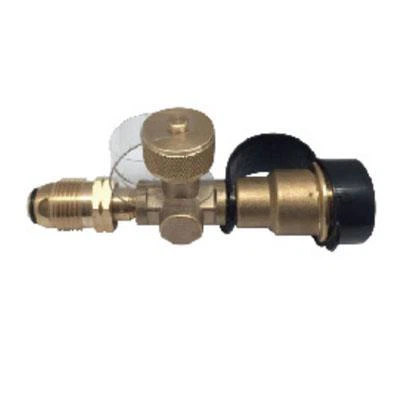
Propane Multi - port Connector for RV are specifically designed for use in recreational vehicles. RVs are constantly on the move, and the propane connectors are exposed to a wide range of environmental conditions. They can experience extreme heat when parked in the sun during the summer and cold temperatures in winter. The thermal expansion properties of these connectors are critical to prevent leaks and ensure reliable operation of propane - powered systems, such as refrigerators, ovens, and heaters, inside the RV.
Industrial Use
In industrial settings, propane connectors are used in large - scale propane storage and distribution systems. These systems may be exposed to more extreme temperature conditions than residential or RV applications. Additionally, the pressure in industrial propane systems can be much higher. The thermal expansion coefficient of the connectors must be carefully considered to prevent any safety hazards or operational issues due to temperature - induced dimensional changes.
Our Propane Connectors and Thermal Expansion
As a propane connector supplier, we understand the importance of the thermal expansion coefficient. We offer a wide range of propane connectors, including Propane Quick Connectors W/Ball Valve and Propane Tank Y Splitter, that are designed with the right materials and construction to handle thermal expansion effectively.
Our connectors are made from high - quality materials with well - understood thermal expansion properties. We conduct extensive testing to ensure that our products maintain their integrity and performance under different temperature conditions. Whether you need a connector for a small residential application or a large industrial system, we have the expertise and products to meet your needs.
Contact Us for Your Propane Connector Needs
If you are in the market for reliable propane connectors, we invite you to contact us for more information. Our team of experts can help you choose the right connectors based on your specific requirements, including the expected temperature range and the application. We are committed to providing high - quality products and excellent customer service to ensure your propane system operates safely and efficiently.

References
- Incropera, F. P., & DeWitt, D. P. (2002). Introduction to Heat Transfer. John Wiley & Sons.
- Callister, W. D., & Rethwisch, D. G. (2011). Materials Science and Engineering: An Introduction. Wiley.


